

























“We’ll monitor it first.”
It’s a common response when a child is newly diagnosed with myopia. Perhaps the degree is still low. Perhaps it does not seem urgent yet. But what many parents may not realise is that myopia progression is cumulative. Each year of unchecked progression quietly adds up – and once the eye elongates, that structural change cannot be reversed.

In Singapore, where myopia rates remain among the highest globally, managing childhood myopia is no longer just about helping children see the whiteboard clearly. It is about protecting long-term eye health.
Today, long-term clinical evidence offers something reassuring: starting early and staying consistent can make a measurable difference.
Why Progression Matters More Than The First Diagnosis
Myopia occurs when the eyeball grows too long, causing distant objects to appear blurry. In childhood, this axial elongation tends to progress most rapidly between ages 5 and 19.
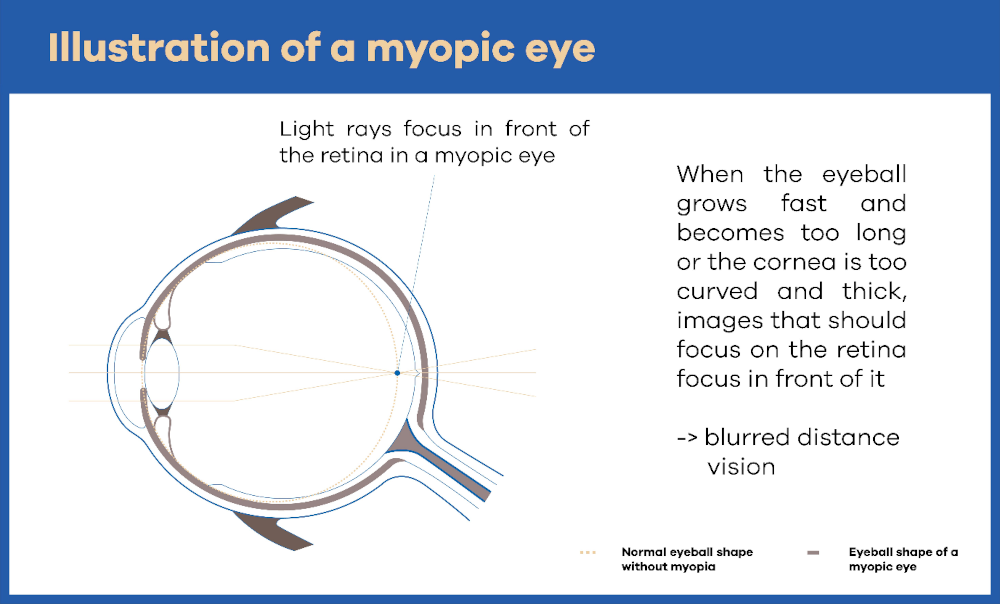
Higher levels of myopia are associated with increased risks of eye conditions later in life, including retinal detachment, glaucoma and myopic macular degeneration.¹ ² In an environment where children balance heavy academic demands with screen exposure, managing progression becomes especially important.
The question is no longer simply whether a child has myopia – but how fast it progresses, and what can be done to slow it down.
What Long-Term Evidence Now Shows
Early research on MiYOSMART spectacle lenses with Defocus Incorporated Multiple Segments (D.I.M.S.) Technology first demonstrated strong short-term results. In a two-year randomized clinical trial, children wearing MiYOSMART experienced 59% less myopia progression and 60% less axial elongation compared to children wearing conventional single vision lenses.³
Those findings established MiYOSMART as an effective myopia management option. But myopia does not stop progressing after two years – so researchers continued following the same group of children.
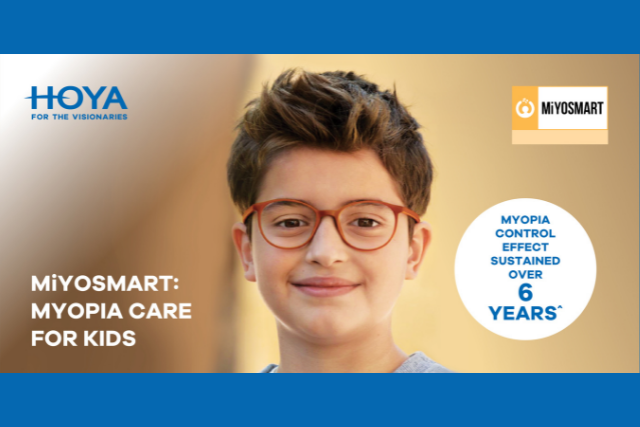
A six-year follow-up study showed that the myopia control effect was sustained over time in children who continued wearing the lenses. Importantly, when compared with initial progression rates, no rebound effect was observed.⁴
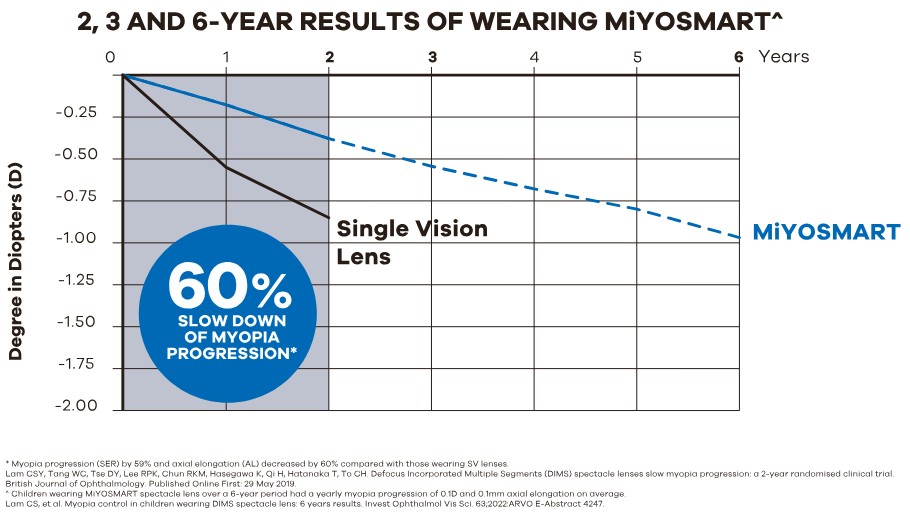
Most recently, data presented at ARVO 2025 extended the timeline even further. The eight-year follow-up study – currently the longest-running myopia management spectacle lens study to date – demonstrated that myopia control was sustained over eight years.⁵ Moreover, children who wore MiYOSMART continuously over a longer duration showed improved myopia management outcomes compared to shorter wearing patterns.⁵
Together, these findings reveal an important insight for parents: myopia management is not a short-term intervention. It is a long-term strategy where consistency matters.
How MiYOSMART Works – Effectively And Safely
MiYOSMART lenses look like regular spectacle lenses but incorporate the award-winning D.I.M.S. Technology. Surrounding a clear central optical zone are hundreds of small segments that create myopic defocus – a signal that helps slow the elongation of the eyeball.³
Encouragingly, research published in 2025 found that children’s vision-related quality of life while wearing MiYOSMART lenses was comparable to those wearing single vision spectacle lenses.⁶ This means children can continue school, sports and daily activities comfortably while the lens works to manage progression.

MiYOSMART lenses are also designed with children in mind: thin, lightweight, impact-resistant and equipped with UV protection. They are water-repellent and easy to clean – practical features for active young wearers.
Designed For The Way Children Live Today
Modern childhood does not happen in just one environment. Children move between digital screens, outdoor activities and shared spaces every day.
This is where MiYOSMART Chameleon Photochromic with HOYA Full Control coating offers an added layer of everyday protection.

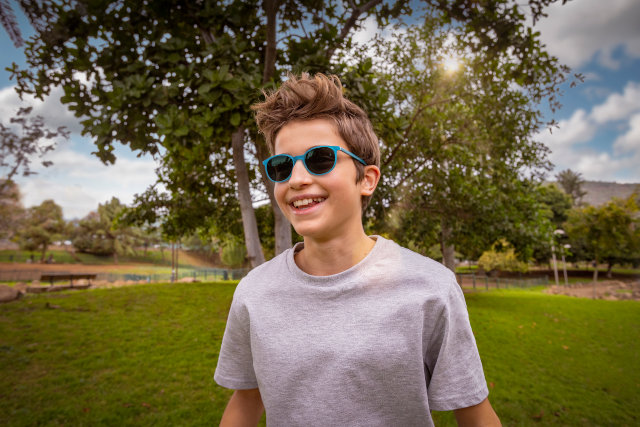
The photochromic feature allows the lenses to automatically darken outdoors in response to sunlight and fade back to clear indoors. This helps children stay visually comfortable across changing light conditions. For children undergoing atropine treatment who may experience light sensitivity due to pupil dilation, adaptive lenses can provide added comfort outdoors.
HOYA Full Control coating supports hygiene maintenance by helping reduce bacterial growth on lens surfaces. It also enhances comfort in a digital world while maintaining easy-care properties.
Instead of managing myopia in isolation, this combination addresses the broader lifestyle demands placed on children’s eyes – indoors, outdoors and on screens.
Take The Next Step Toward Long-Term Vision Protection

The hidden cost of waiting is cumulative progression. Each incremental increase in prescription reflects further elongation of the eye.
With sustained clinical evidence now extending up to eight years, parents can make informed, proactive decisions grounded in long-term data.
To explore how MiYOSMART can support your child’s eye health:
👉 Try the Myopia Simulator to see potential progression scenarios: here
👉 Hear from other parents and children on the MiYOSMART Testimonial Website: here
👉 Find an eye care practitioner near you: here
For more detailed information about MiYOSMART Chameleon Photochromic with HOYA Full Control coating, visit: here
Because when it comes to your child’s vision, early and consistent care today can help protect what matters most tomorrow.
References
¹ Khokhar M. Myopia: An epidemic of global proportions. Optometry Times. 2020.
² National University Hospital Singapore. Myopia complications. nuh.com.sg.
³ Lam CSY, Tang WC, Tse DY, et al. Defocus Incorporated Multiple Segments (DIMS) spectacle lenses slow myopia progression: a 2-year randomised clinical trial. British Journal of Ophthalmology. Published online 29 May 2019.
⁴ Six-year follow-up clinical study on MiYOSMART spectacle lenses. Data presented 2024–2025.
⁵ Leung TW, et al. Comparison of Myopia Progression in Individuals Wearing Defocus Incorporated Multiple Segments (DIMS) Spectacle Lenses for Eight Years versus Shorter Durations. Abstract presented at ARVO 2025.
⁶ Li X, Ma W, Song Y, Yap M, Liu L. Comparison of Myopic Progression and Quality of Life Wearing Either DIMS Lenses or Single-Vision Myopia Correcting Spectacles. Journal of Ophthalmology. 2025.
Disclaimer: Results from using Miyosmart Sun lenses may vary based on individual factors. This article provides general information and does not guarantee specific outcomes. Please consult an eye care professional for personalised advice.
This post is brought to you by HOYA Lens Singapore.
By Joanne Heng.
* * * * *
Looking to reach over 100,000 parents in Singapore? Let us amplify your message! Drop your contact details here, and we’ll reach out to you.
Discover exciting family-friendly events and places to explore! Join our Telegram and Instagram for curated parenting recommendations.