


































Neptune, the most distant planet in our Solar System, is set to reach opposition on 26 September 2026, marking one of the best opportunities of the year to observe the elusive blue planet.
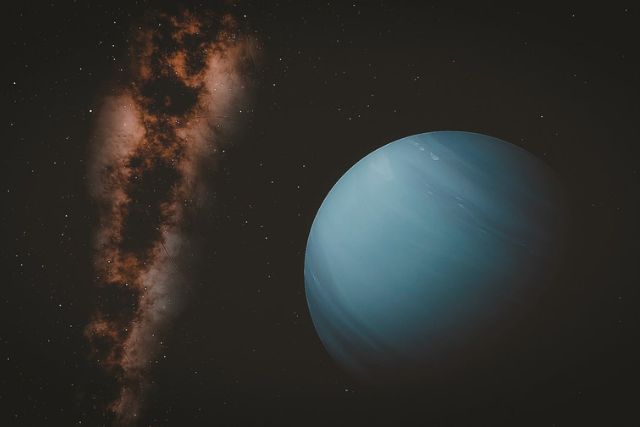 Image: Pixabay
During opposition, Earth passes between the Sun and Neptune, bringing the planet closest to Earth and making it appear at its brightest for the year. Neptune will also be visible for much of the night, rising in the east around sunset and reaching its highest point in the sky around midnight.
Despite being at its brightest, Neptune remains too faint to be seen with the naked eye. With a telescope and favourable viewing conditions, observers may be able to spot the planet as a small, blue or blue-green disc against the night sky.
The Science Centre Observatory has put together the attached list of FAQs addressing common questions about Neptune at Opposition, including what the phenomenon means, why opposition is the best time to observe Neptune, and tips for spotting the planet in Singapore.
1. What is Neptune at Opposition?
Opposition occurs when Earth passes between the Sun and a planet farther out in the Solar System, placing the planet and the Sun on opposite sides of Earth.
Around opposition, Neptune is at its closest to Earth for the year and appears at its brightest. It is also visible for much of the night, making this one of the best periods of the year to observe the distant planet.
2. What does it mean when a planet is “at opposition”?
A planet is said to be at opposition when Earth is positioned approximately between the Sun and the planet, causing the planet to appear opposite the Sun in our sky.
This means that as the Sun sets in the west, the planet rises in the east and remains visible for much of the night. Opposition also occurs around the time when the planet is closest to Earth, making it appear brighter than at other points in the year.
Only planets orbiting farther from the Sun than Earth can reach opposition. These include Mars, Jupiter, Saturn, Uranus and Neptune.

3. Why is opposition the best time to observe Neptune?
Opposition provides particularly favourable viewing conditions because Neptune is closest to Earth and at its brightest for the year. It is also positioned opposite the Sun in Earth’s sky, meaning it is visible for much of the night and reaches its highest point around midnight. For stargazers and astrophotographers, it’s an ideal time to view and photograph the superior planets.
However, Neptune remains extremely distant even at opposition. It is the eighth and most distant planet from the Sun, orbiting at an average distance of approximately 4.5 billion kilometres from the Sun, or around 30 times the distance between Earth and the Sun.
4. How often does Neptune reach opposition?
Neptune reaches opposition approximately once every year. More precisely, successive oppositions occur about 367 days apart on average.
This happens because Earth completes its orbit around the Sun much faster than Neptune. Neptune takes approximately 165 Earth years to complete a single orbit around the Sun, while Earth takes one year. As Earth catches up with and passes between Neptune and the Sun, another opposition occurs.
5. When will Neptune be at opposition in Singapore?
Neptune will reach opposition on 26 September 2026. Around opposition, Neptune will be visible for much of the night, rising in the east around sunset and reaching its highest point in the sky around midnight.
For the best chance of observing Neptune, viewers should look for it when it is higher in the night sky and from a location with an unobstructed view and minimal light pollution.
6. Can Neptune be seen with the naked eye?
Despite being at its brightest around opposition, Neptune is too faint to be seen with the naked eye.
Observers will require optical equipment to locate it. A telescope is recommended for viewing Neptune, which will appear as a small, blue-hued point or disc depending on the telescope and observing conditions. A sky chart or astronomy application can also help observers locate the planet against the surrounding stars.
In 2026, Neptune will be located in the constellation Pisces during opposition.
7. Where is the best place to view Neptune in Singapore?
As Neptune is a relatively faint object, viewing conditions are important. Observers should seek a location with minimal artificial lighting, clear skies and an unobstructed view of the night sky such as parks, beaches and reservoirs. In Singapore, suitable locations include East Coast Park, Marina Barrage or the Southern Ridges.
Unlike brighter planets such as Jupiter and Saturn, Neptune cannot be spotted simply by looking towards the correct part of the sky. A telescope and a detailed sky chart or astronomy application are recommended to identify it among the surrounding stars.
Regardless of location, viewers should avoid looking at bright screens before observing and allow their eyes time to adapt to the dark.
8. What will Neptune look like through a telescope?
Through most amateur telescopes, Neptune will appear as a very small, blue or blue-green disc, rather than displaying the level of detail commonly visible when observing planets such as Jupiter or Saturn.
9. Why is Neptune blue?
Neptune’s atmosphere is composed primarily of hydrogen and helium, with a smaller amount of methane. Methane absorbs red wavelengths of light and contributes to the planet’s characteristic blue appearance.
Under suitable conditions and with sufficiently powerful equipment, experienced observers may also be able to identify Triton, Neptune’s largest moon, close to the planet.
Contributed by Science Centre Observatory.
Mid-Autumn Festival falls on 25 September this year. Remember to check out our list of Best Mooncakes and Best Bak Kwa in Singapore 2026.

Looking for what to do during the Mid-Autumn Festival? Read Mid Autumn Festival 2026 Events in Singapore.

Children’s Day
Children’s Day is on 2 October 2026. Do check out our list of fun Things To Do This Children’s Day long weekend.

Children’s Day Promotions
From free kids meals to special discounts, these restaurants, eateries and businesses are celebrating this special day together with your little ones. Find out more via Money-Saving Children’s Day Promotions You Need to Know

* * * * *
Looking to reach over 100,000 parents in Singapore? Let us amplify your message! Drop your contact details here, and we’ll reach out to you.
Discover exciting family-friendly events and places to explore! Join our Telegram, Instagram and Tik Tok for curated parenting recommendations.