














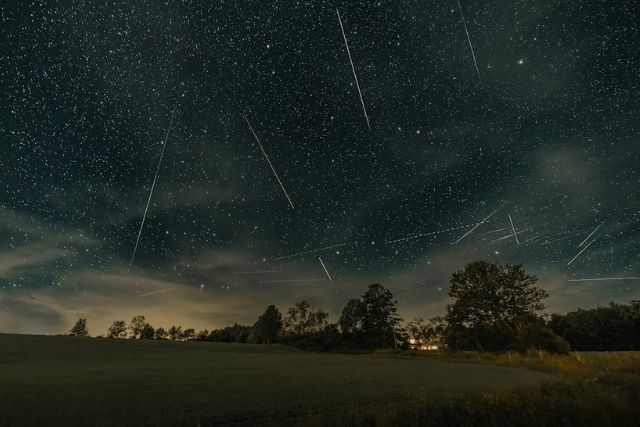

















The next active meteor shower of the month, the Orionid Meteor Shower, is set to return towards the end of October, with its peak expected overnight on 21–22 October.
The Orionids occur as Earth passes through a trail of debris left behind by Comet 1P/Halley. As these particles enter Earth’s atmosphere at high speeds, they burn up and create bright streaks of light across the night sky. Known for their speed, the Orionids occasionally leave glowing trails, or “trains”, that persist for several seconds after the meteor has passed.
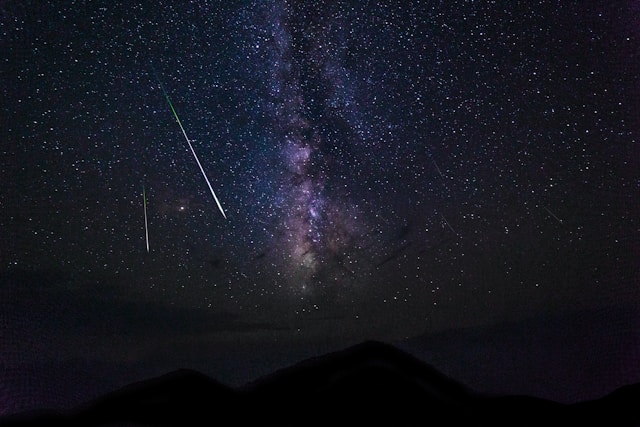 Image: Unsplash
1. What is the celestial event happening on 21-22 October?
The Orionid Meteor Shower is an annual meteor shower that occurs every October. In 2026, the Orionid Meteor Shower is expected to peak overnight on 21-22 October.
The event occurs when Earth passes through a trail of debris left behind by Comet 1P/Halley. When Earth passes through this debris, the particles enter the atmosphere at extremely high speeds, at about 41 miles per second for the Orionids. The intense compression and heating of the air causes the particles to burn up, creating the bright streaks of light in the sky.
Under a dark sky with no moon and ideal viewing conditions, observers may see up to 10 to 20 meteors per hour, frequently appearing as white streaks of light. Actual numbers in Singapore are usually lower due to light pollution and frequent cloud cover.
In addition, the shower’s peak coincides with a full moon on 25-26 October, which may result in fewer meteors being observable throughout the night due to the brightness of the moon.

2. How did the Orionid Meteor Shower get its name?
Meteor showers are named after the constellation from which the meteors appear to originate, known as the radiant. The Orionid Meteor Shower derived its name from the constellation Orion, where the meteors appear to radiate from this region of the sky, though their true origin lies elsewhere in space.
3. What time will the Orionid Meteor Shower be visible in Singapore?
In Singapore, the Orionid Meteor Shower is best observed during the wee hours past midnight, especially at 2a.m., during which the constellation from the meteors appears to radiate rises sufficiently above the horizon, making the shower easier to observe.
No special equipment is required to see the Orionid Meteor Shower in Singapore. Simply allow your eyes about 20–30 minutes to adjust to the darkness for the best chance of spotting meteors.
4. How often do meteor showers occur?
Meteor showers are formed rather frequently when the Earth travels through various clouds of interplanetary debris left behind from the tail of comets or asteroids that have thrown out large amounts of materials. The denser the debris clouds are, the more materials will fall on Earth, thus giving us more meteors. Meteors are made of bits of rocks and ice ejected from comets or asteroids.
While the Earth orbits the Sun and crosses into these dust streams or debris trails, the materials collide into Earth’s atmosphere and burn up, leaving a streak in the sky which is what we see as meteors.
5. What are the best places to view the Orionid Meteor Shower?
The best viewing locations are areas with minimal artificial lighting and an unobstructed view of the sky. In Singapore, suitable locations include parks, beaches and reservoirs that are away from city lights, such as East Coast Park, Changi Beach Park, West Coast Park, Marina Barrage or the Southern Ridges. Regardless of location, viewers should avoid looking at bright screens before observing and allow their eyes time to adapt to the dark.
6. Can the meteor shower be viewed with the naked eye?
Yes. Meteor showers are best viewed with the naked eye, as telescopes and binoculars have a limited field of view and may cause observers to miss meteors streaking across different parts of the sky. Simply find a dark location, look broadly across the sky rather than directly at Orion, and be patient.
7. When is the next time we will be able to see a meteor shower in Singapore?
Following the Orionid Meteor Shower, the next meteor shower visible in Singapore is the Taurids Meteor Shower, which is active throughout October and November, and typically peaks around 4-5 November.
8. What is special about the Orionid Meteor Shower?
The Orionids are one of two annual meteor showers associated with Comet 1P/Halley, the other being the Eta Aquarids in May. What makes the Orionids notable is that they are fast-moving meteors, occasionally leaving trails or “trains” that can persist for several seconds after the meteor has passed.
Contributed by Science Centre Observatory.
Halloween is on 31 October and is creeping up fast. We have compiled a list of Halloween parties in Singapore just for you!

It is the year-end November & December holidays. We have compiled a list of November-December School Holidays 2026 Activities for Kids. Click on the image below to find out more.

* * * * *
Looking to reach over 100,000 parents in Singapore? Let us amplify your message! Drop your contact details here, and we’ll reach out to you.
Discover exciting family-friendly events and places to explore! Join our Telegram, Instagram and Tik Tok for curated parenting recommendations.