































Saturn, the second-largest planet in our Solar System, is set to reach opposition on 4 October 2026, marking one of the best opportunities of the year to observe the ringed planet.
What makes the 2026 opposition particularly notable is the timing of Saturn’s rings – the rings appeared edge-on to Earth in early 2025 and became extremely difficult to observe. By the time of the 2026 opposition, they will have tilted back into view at approximately 7.5 degrees south, allowing telescopes to once again reveal Saturn’s iconic rings.
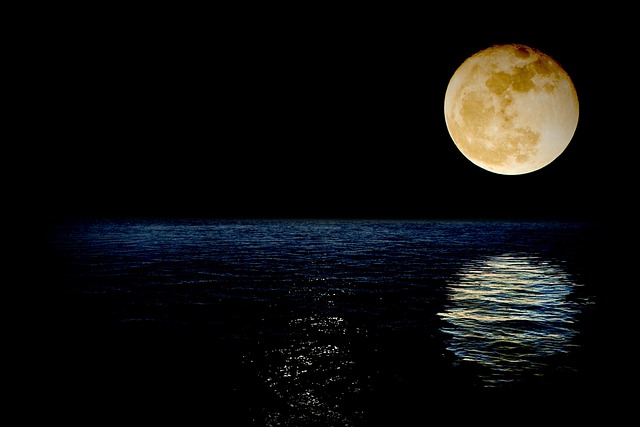
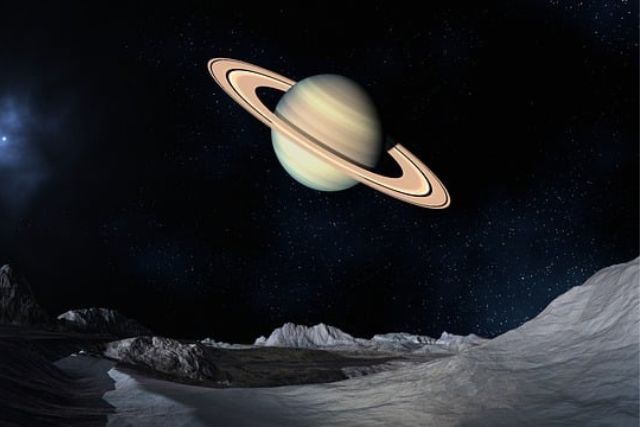 Image credit: Pixabay
No special equipment is needed to enjoy the view, though binoculars or a telescope will reveal even more detail, including Saturn’s iconic rings and possibly some of its moons.
About Planet Oppositions
1. What is a planet opposition?
In our Solar System, an opposition occurs when Earth lies directly between the Sun and another planet/planetary body, forming an imaginary straight line connecting all three.
2. What is Saturn at Opposition?
Opposition occurs when Earth passes between the Sun and a planet farther out in the Solar System, placing the planet and the Sun on opposite sides of Earth.
Around opposition on 4 October, Saturn is at its closest to Earth for the year and appears at its brightest. It is also visible for much of the night, making this one of the best periods of the year to observe the distant planet.
3. What does it mean when a planet is “at opposition”?
A planet is said to be at opposition when Earth is positioned approximately between the Sun and the planet, causing the planet to appear opposite the Sun in our sky.
This means that as the Sun sets in the west, the planet rises in the east and remains visible for much of the night. Opposition also occurs around the time when the planet is closest to Earth, making it appear brighter than at other points in the year.
Only planets orbiting farther from the Sun than Earth can reach opposition. These include Mars, Jupiter, Saturn, Uranus and Neptune.

4. Why is opposition the best time to observe Saturn?
Opposition provides particularly favourable viewing conditions because Saturn is closest to Earth and at its brightest for the year. It is also positioned opposite the Sun in Earth’s sky, meaning it is visible for much of the night and reaches its highest point around midnight. For stargazers and astrophotographers, it’s an ideal time to view and photograph the superior planets.
What makes the 2026 opposition particularly notable is the timing of Saturn’s rings. The rings appeared edge-on to Earth in early 2025 and became extremely difficult to observe. By the time of the 2026 opposition, they will have tilted back into view at approximately 7.5 degrees south, allowing telescopes to once again reveal Saturn’s iconic rings.
5. How often does Saturn reach opposition?
Saturn reaches opposition approximately every earthly year. More precisely, successive oppositions occur about 378 days apart on average, with opposition coming about two weeks later each year.
This happens because Earth completes its orbit around the Sun much faster than Saturn, which takes approximately 29.4 Earth years to complete a single orbit around the Sun. As Earth catches up with and passes between Saturn and the Sun, another opposition occurs.
6. When will Saturn be at opposition in Singapore?
Saturn will reach opposition on 4 October 2026. Around opposition, Saturn will be visible for much of the night, rising in the east around sunset and reaching its highest point in the sky around midnight.
For the best chance of observing Saturn, viewers should look for it when it is higher in the night sky and from a location with an unobstructed view and minimal light pollution.
The next Saturn at Opposition will occur on 18 October 2027.
7. Can Saturn be seen with the naked eye?
Yes, Saturn can be easily seen with the naked eye during opposition, appearing as a steady golden point of light.
No special equipment is needed to enjoy the view, though binoculars or telescopes will reveal even more detail.
In 2026, Saturn will be located near the constellation Cetus during opposition.
8. Where is the best place to view Saturn in Singapore?
The best viewing locations are areas with minimal artificial lighting and an unobstructed view of the sky. In Singapore, suitable locations include parks, beaches and reservoirs that are away from city lights, such as East Coast Park, Changi Beach Park, West Coast Park, Marina Barrage or the Southern Ridges. Regardless of location, viewers should avoid looking at bright screens before observing and allow their eyes time to adapt to the dark.
9. What will Saturn look like through a telescope?
Through most amateur telescopes, observers should also be able to see Saturn’s iconic rings, with the southern side of the ring plane tilted toward Earth, offering an especially rewarding view for stargazers.
This article is The Observatory at Science Centre Singapore
Halloween is on 31 October and is creeping up fast. We have compiled a list of Halloween parties in Singapore just for you!

It is the year-end November & December holidays. We have compiled a list of November-December School Holidays 2026 Activities for Kids. Click on the image below to find out more.

* * * * *
Looking to reach over 100,000 parents in Singapore? Let us amplify your message! Drop your contact details here, and we’ll reach out to you.
Discover exciting family-friendly events and places to explore! Join our Telegram channel for curated parenting recommendations.