














What makes an object Peranakan? Opening on 30 October 2026, Exceptional/Everyday: New Acquisitions, New Perspectives at the Peranakan Museum explores this question through recent acquisitions, many on view for the first time. Rather than offering a single answer, the exhibition reveals the rich ambiguity of Peranakan culture and the spectrum of responses among maker, owner, and object.
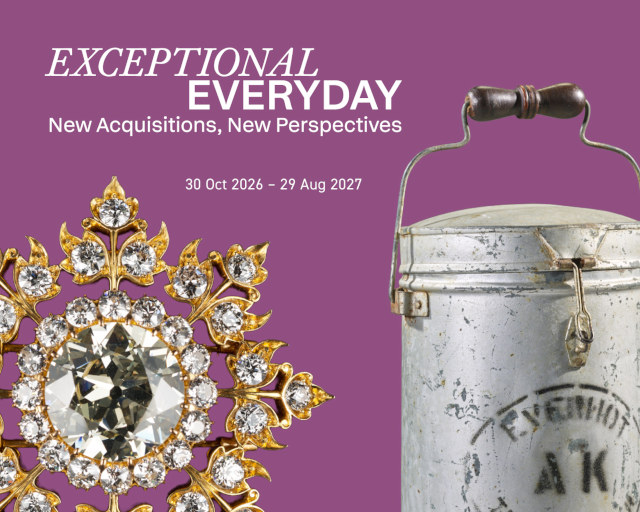
The exhibition brings together over 150 objects across 14 stories, from porcelain and furniture to clothing and jewellery. Organised around three themes – “Identity”, “Buying”, and “Creating” – these works range from the everyday to the exceptional, and the mass-produced to the bespoke. They reveal how Peranakan communities acquired, adapted, and made things in response to the multicultural environments in which they lived.
Rather than offering fixed definitions, the objects in this exhibition reveal Peranakan culture as something continually negotiated through identity, consumption, and creation. They remind us that material culture is not static, it is shaped by the choices people make over time. What emerges is not a single definition of Peranakan culture, but a richer understanding of how cultures take shape.
Mr Clement Onn, Director of Asian Civilisations Museum and Peranakan Museum, says, “Everyday objects can tell extraordinary stories. Exceptional/Everyday: New Acquisitions, New Perspectives invites us to rethink what makes an object Peranakan. The exhibition brings together new acquisitions that reveal creativity, changing taste and personal stories behind Peranakan culture. Many of these objects have been generously gifted by families and donors, allowing us to preserve not just beautiful things, but the memories and lives connected to them. The exhibition reminds us that Peranakan culture is not simply a thing of the past. It continues to evolve, shaped by each generation”
Inventing a Peranakan Museum
The exhibition begins with the first known Peranakan object to enter the National Collection: a coral-red kamcheng acquired by the National Museum in 1963. At the time, interest in Peranakan material culture was growing among collectors and in the local press, prompting the museum to begin preserving and documenting these objects. By 1985, it had acquired enough to establish a Straits Chinese gallery.
Today, the Peranakan Museum’s collection has grown to some 12,000 objects, acquired through a focused collecting strategy and the generosity of donors. This section explores how the museum’s approach to collecting has evolved, bringing new objects and perspectives into the collection and broadening our understanding of Peranakan culture.
Identity
Peranakans have lived in multicultural environments for centuries, developing many ways of presenting themselves in public and in private. These chameleon-like qualities helped them navigate different social, political, and religious circumstances. Documents, portraits, photographs, and garments reveal the varied ways they dressed, practised their customs, and expressed their identities
Ancestral portraits were closely associated with Chinese ancestral veneration rites but also show how Peranakans expressed themselves and adapted to changing fashions. Little is known about Peranakans living in the Javanese hinterlands, making this portrait particularly revealing. The sitter wears a Chinese shirt and trousers with a Western-style jacket, leather pumps, and a carved cane. His jacket combines Chinese frog buttons with Western-style lapels and tailoring, perhaps in response to Dutch colonial restrictions on non-Europeans wearing European suits. The result was a new style that did not conform to fashions elsewhere.
From the early twentieth century, the Chinese samfoo (a collared blouse with frog buttons worn with trousers) became part of Peranakan women’s increasingly varied wardrobes. It could be worn as workwear, domestic attire, or fashionable dress. Rather than replacing existing styles, the samfoo expanded women’s clothing choices, creating a more fluid relationship between dress and identity.
This samfoo belonged to Oei Seng Neo (1923-2001) who was born in Tanjung Pinang in the Riau Islands and later moved to Singapore. She wore samfoos at home and grew up in an environment that combined the customs of her native and adopted lands.
Buying
When does a purchased item become Peranakan? As long-established residents of Southeast Asian port cities, Peranakans bought a wide range of goods from local and overseas markets, including objects made specifically for them and mass-produced items shared with other communities. Some were expensive, while others were affordable and readily available. Their associations with Peranakan culture often lay not in how or where they were made, but in how they were used and adapted
Tiffin carriers known as tengkat (“levels”) in Baba Malay, were common household items in the nineteenth and twentieth centuries. Plain versions were widely used in Peranakan households, although brightly coloured floral examples have more recently come to be identified – often misleadingly – as distinctively “Peranakan”.
This tengkat was purchased by Lim Yeok Quan (1888-1959) and her husband, Ong Peng Hock (1889-1968) in Bangalore, where they sought refuge before the Japanese invasion of Singapore. Back in Singapore, the Ong family used it to carry offerings to the family cemetery near Bukit Brown during the annual Cheng Beng festival.
Decorated with phoenixes and peonies on green and lilac grounds, and goldfish inside, this pair of kamchengs belonged to Chung Guat Hooi (1925-1995), daughter of Perak’s last Kapitan Cina, Chung Thye Pin (1879-1935). They may have been inherited from either of her parents. Numerous kamchengs of the same design, colour, and size survive, suggesting that they were produced in multiples for export rather than individually commissioned.
Creating
It is perhaps in the special commissioning and personal creation of objects that the breadth of Peranakan identity can be seen in all its diversity. Peranakans ordered things with special designs from foreign and local craftsmen, not only to enhance their auspicious significance, but also to express their modernity. These objects, whether textiles, jewellery, or furniture, are exceptional for their uniqueness and quality. They also challenge the limits of extravagance.
Peranakan brides in Singapore and Malacca wore the bim poh kemanteng (bridal handkerchief) on the first and fifth days of wedding celebrations. This example was worn by Khoo Gek Choo (1919-1996) when she married Oh Kwee Liang (1916-1987) in 1940. More than a hundred jewelled ornaments are appliquéd to its surface using different gem-setting and goldworking techniques. Their variety suggests that the jewels were inherited and assembled over several generations, probably passing to Gek Choo through her mother and grandmother
Beyond these are the personal artistic creations of Peranakans, represented in the exhibition by beadwork made by Alice Choo Joo Kim (1926-2019). Her fashionable accessories display a mastery of technique, playful modernity, and unconventional pattern.
One of her clutch purses features palm trees shading a camel and an elephant, mixing elements of tropical, desert, and jungle landscapes. The unexpected combination gives the accessory a distinctive character, showing how personal creations offered opportunities for individual expression.
Hands-on encounters with Peranakan material culture
A range of hands-on and family-friendly activities offer further ways to engage with the exhibition. Discovery Corners on Levels 2 and 3 introduce ceramics, furniture, and beadwork through tactile activities, while an activity trail booklet encourages visitors ages 7 and above to look closely at the objects on display.
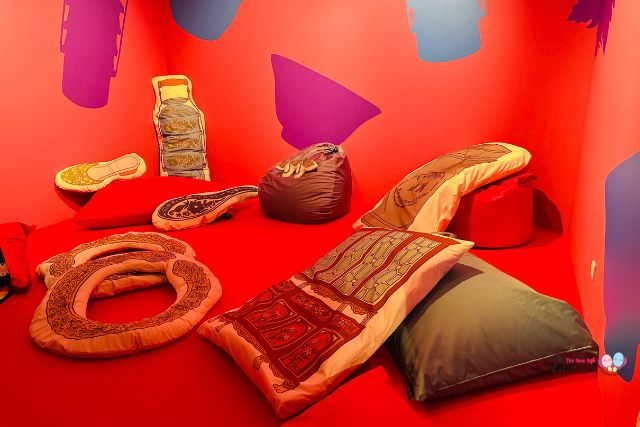
On Level 2, an Activity Space designed by Singaporean visual artist HAFI takes inspiration from the exhibition, inviting visitors to create self-portraits, design objects, and play with oversized soft sculptures.
Exceptional/Everyday: New Acquisitions, New Perspectives runs from 30 October 2026 to 29 August 2027 at the Special Exhibitions Gallery of the Peranakan Museum, admission charges apply. For more information, please visit here.
It’s the weekend and are you looking for things / activities to do? Check out our weekly roundup of things to do this weekend.

For other upcoming events, visit Events in Singapore.
* * * * *
Looking to reach over 100,000 parents in Singapore? Let us amplify your message! Drop your contact details here, and we’ll reach out to you.
Discover exciting family-friendly events and places to explore! Join our Telegram, Instagram and Tik Tok for curated parenting recommendations.